AI EI Report: 5 Growth Steps
Have you ever finished an online quiz and wondered, "What do I actually do with these numbers?" Many people take an ei test to see where they stand, but a simple score doesn't tell the whole story. You might see that you scored high in empathy but lower in stress management. While that information is helpful, it doesn't provide a roadmap for your personal or professional life.
How can you turn a digital score into real-life progress?
The answer lies in moving beyond basic results. By using a personalized AI EI report, you can bridge the gap between curiosity and actual growth. This guide will walk you through exactly how to interpret your results and use them to build a better version of yourself. If you haven't started yet, you can try our free tool to get your baseline score today.

Understanding Your Personalized AI EI Analysis
When you take a standard emotional intelligence test, you usually get a set of percentages. However, your personality is more complex than a few charts. An AI-driven analysis looks at how your answers connect. It identifies patterns that a human might miss. This personalized approach ensures that the advice you receive is specific to your unique life situation.
Understanding this analysis is the first step in your emotional intelligence action plan. Instead of looking at your score as a "grade," view it as a snapshot of your current emotional habits. These habits are not fixed; they are skills that you can improve with the right information.
How AI Transforms Raw Data into Actionable Insights
Standard tests often treat questions as isolated points. AI analysis is different. It uses advanced algorithms to find correlations between your different responses. For example, if you show high social awareness but low relationship management, the AI recognizes that you might understand people well but struggle to handle conflict.
By processing this data, the system generates a personalized EI report guide that highlights these specific gaps. It moves beyond "what" your score is and explains "why" you might feel a certain way in social settings. This depth allows you to focus your energy on the areas that will make the biggest difference in your daily life. To see this technology in action, you can start your test and explore the AI feedback options.

Decoding the Four Dimensions of Your Emotional Intelligence Profile
Most modern EI frameworks, including those powering our platform, are built on four core pillars. Your AI report breaks these down so you can see your "emotional fingerprint."
- Self-Awareness: This is your ability to recognize your own emotions as they happen.
- Self-Management: This involves controlling impulsive feelings and behaviors.
- Social Awareness: This is how well you understand the emotions and concerns of other people.
- Relationship Management: This is your skill in developing and maintaining good relationships.
Your report doesn't just give you a total score for these areas. It looks at the nuances. You might be great at self-awareness in a calm environment but lose it during a crisis. The AI identifies these "situational triggers," giving you a much clearer picture of your emotional health.
Implementing Your EI Growth Strategy
Once you have your personalized EI strategies in hand, the next phase is action. Growth doesn't happen by reading a report; it happens by changing how you interact with the world. You need a structured way to apply your new knowledge.
Think of your EI development like physical fitness. You wouldn't expect to run a marathon after reading one book on exercise. Similarly, you shouldn't expect to master your emotions overnight. By following these five growth steps, you can create lasting change.
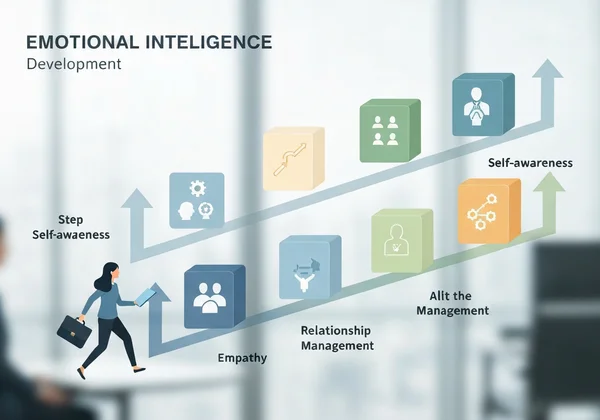
Step 1 - Building Self-Awareness Through Daily Reflection
Self-awareness is the foundation of all emotional intelligence. If you don't know what you are feeling, you cannot manage it. Your AI report might suggest that you are "emotionally avoidant" or "highly reactive."
To improve this, start a daily reflection habit. Spend five minutes every evening asking yourself: "When did I feel most stressed today?" and "How did my body react?" Perhaps your shoulders got tight or your heart rate increased. Recognizing these physical signs helps you catch emotions before they overwhelm you. This is a core part of any emotional intelligence action plan.
Step 2 - Strengthening Self-Management Techniques
After you learn to recognize your feelings, you must learn to manage them. If your ei test results show a need for better self-regulation, focus on the "pause."
When you feel a strong emotion, like anger or frustration, wait ten seconds before speaking or typing an email. Use this time to breathe and ask if your reaction matches the situation. Your AI report provides specific "micro-habits" for this. These might include deep breathing exercises or "reframing" a negative thought into a neutral one. Over time, these small actions rewire how your brain handles stress.
Step 3 - Enhancing Social Awareness in Interactions
Social awareness is about looking outward. It involves active listening and empathy. If your report indicates that you sometimes miss social cues, you can practice "active observation."
During your next meeting or lunch with a friend, focus entirely on the other person. Notice their tone of voice and their body language. Are they saying they are "fine" but looking at the floor? By paying closer attention to others, you build the "empathy muscle." This makes you a better friend, partner, and colleague. If you want to see how your social skills rank, you can take an online ei test right now.
Step 4 - Mastering Relationship Management Skills
This is where all your other skills come together. Relationship management is about using your emotional awareness to handle interactions successfully.
Mastering this skill involves learning how to give and receive feedback without getting defensive. It also means learning how to inspire others and manage conflict. If your AI report points out that you struggle with difficult conversations, start by practicing "I" statements. Instead of saying, "You make me angry," try saying, "I feel frustrated when this happens."
Step 5 - Applying Insights to Career and Personal Goals
The final step is to align your emotional skills with your long-term goals. If you are a student, you might use your improved self-management to stop procrastinating. If you are a manager, you might use social awareness to better support your team.
Your AI report often includes a section on "Professional Impact." Use this to identify which EI skill will help you get your next promotion or build a stronger bond with your family. By setting specific goals, your growth becomes measurable and rewarding.
Tracking Your EI Development Journey
Improvement is a process, not a destination. One of the biggest mistakes people make is taking an emotional intelligence test once and never looking at it again. To see real results, you must track your progress over months, not days.
Your AI report acts as a baseline. As you work on the steps mentioned above, your emotional responses will change. Tracking this journey keeps you motivated and helps you identify which strategies are working best for your personality.
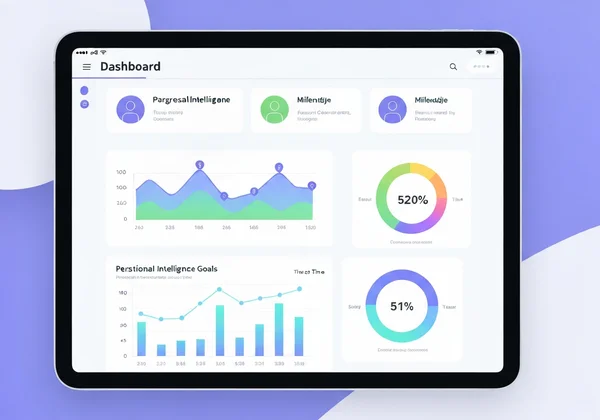
Creating Personalized EI Milestones
Break your growth into small, manageable wins. Instead of trying to "be more empathetic" generally, set a milestone like: "In the next two weeks, I will ask three open-ended questions in every conversation."
Other milestones could include:
- Meditating for 10 minutes, three times a week, to improve focus.
- Successfully resolving one workplace conflict using "I" statements.
- Identifying three emotional triggers during a high-stress week.
When you reach these milestones, acknowledge your hard work. Emotional growth is difficult, and every small victory counts toward your overall emotional intelligence score.
Measuring Progress Beyond the Numbers
While retaking the test is a great way to see data, you should also look for "real-world" signs of progress. You will know you are growing when:
- You stay calm during a heated argument.
- People start coming to you for advice or support.
- You feel less exhausted after a long day of social interaction.
- You can admit when you are wrong without feeling ashamed.
These changes are often more meaningful than a numerical score. However, many users find it helpful to see your results every few months to see how their "emotional profile" has shifted.
Conclusion
Embracing your emotional growth isn’t just about scores—it’s about unlocking everyday resilience. Think of your AI EI report as a coach that spots subtle patterns you might miss. An AI EI report acts like a digital mentor. Beyond scores, it reveals why you react a certain way—and how to grow.
You now have the steps to build self-awareness, manage your reactions, and lead a more fulfilling life. Remember, the goal is not perfection. The goal is progress. Every time you choose to reflect rather than react, you are building a stronger, more resilient mind. Whether you are a student looking for an edge or a professional aiming for leadership, your emotional skills will always be your greatest asset.
Are you ready to see what your data says about you? Start your free ei test today and unlock the personalized insights you need to grow.
FAQ Section
How accurate are AI-generated EI reports compared to human analysis?
Our AI dives deeper than human analysis by mapping thousands of response connections—like how your stress responses might secretly undermine empathy. AI reports uncover patterns humans miss by analyzing thousands of data connections. This ensures your feedback is both precise and deeply personalized. Our technology is built on established psychological frameworks to ensure the feedback you receive is both scientific and practical.
Can I retake the EI test to see if my report changes?
We actually encourage regular check-ins. Many users take an ei test online every three to six months to monitor their evolution. This allows you to see how your scores improve after practicing the growth steps. Since emotional intelligence is a set of skills, your report will naturally change as you develop better habits and coping mechanisms.
What makes the AI EI report different from standard EI test results?
Standard results usually provide a basic "high, medium, or low" score for different categories. Our AI-driven report goes much deeper by explaining the relationship between those categories. For instance, it might explain how your high self-awareness is currently being blocked by a lack of self-regulation techniques. It provides a narrative and an action plan rather than just a number.
How long does it take to see noticeable improvements in my emotional intelligence?
Most people begin to notice small changes in their reactions within two to four weeks of consistent practice. Significant changes in your relationships and career usually take three to six months of dedicated work. Emotional intelligence is like a muscle; the more you use it, the stronger it gets. Consistent use of your personalized EI strategies is the key to long-term success.