EI Test Responses: Decoding Your Emotional Intelligence Patterns
Many people take an emotional intelligence test hoping for a single, defining number. We want a score that tells us, "You're good at this," or "You need to work on that." But what if the real insights aren't in the final score, but hidden within the unique patterns of your answers?
What if the way you answer questions reveals more than the answers themselves?
This article explores how your response patterns on an EI test can uncover hidden strengths, unconscious biases, and crucial behavioral blind spots. We will show you how moving beyond the score can unlock a profound level of self-awareness. With advanced tools like our AI-powered analysis, you can transform these patterns into a clear roadmap for personal and professional growth. Are you ready to start your test and see what your answers truly reveal?

Understanding EI Test Interpretation Beyond the Score
Getting your emotional intelligence score is a great first step. It gives you a general benchmark. However, a single number simplifies the rich complexity of your inner world. To truly grow, explore what drives your score—not just the number itself.
Why Your Response Patterns Offer Deeper Insights
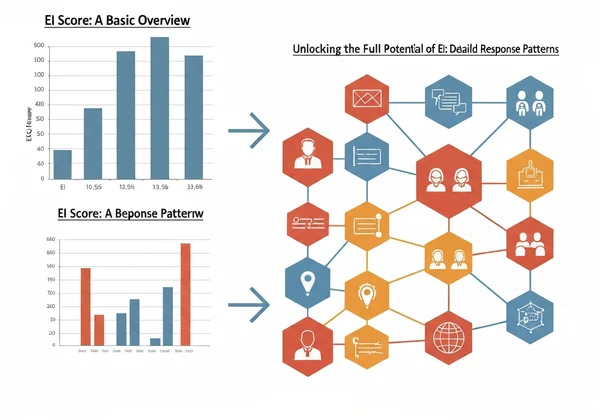
Think of an EI score as the final destination on a map. It tells you where you ended up, but it doesn’t show the route you took. Your response patterns are that route. They reveal your emotional habits and thought processes in action.
For example, do you consistently rate yourself highly on empathy but struggle with questions about handling conflict? This pattern suggests a disconnect between your perceived empathy and your ability to apply it under pressure. A simple score might average this out, but the pattern highlights a specific area for growth. It shows the difference between knowing a skill and using it effectively.
Common Self-Assessment Biases and Their Impact on EI Scores
We are not always the most objective judges of ourselves. Psychological research shows that self-assessment is often colored by unconscious biases. These can significantly affect your EI score.
Some common biases include:
- Social Desirability Bias: This is the tendency to answer questions in a way that you believe will be viewed favorably by others. Do you ever choose answers that sound ideal, not honest, instead of reflecting your true feelings?
- The "Better-Than-Average" Effect: Most people tend to believe they are better than average in various skills, including emotional ones. This overconfidence can inflate your score, masking areas that genuinely need attention.
- Mood-Congruent Bias: Your current mood can heavily influence your answers. If you take the test on a bad day, your responses might be far more negative than usual, and vice-versa.
These biases don't make the test useless. Instead, they make pattern analysis essential. A sophisticated system works to identify these inconsistencies. It looks for contradictions between how you view yourself (Self-Report) and how you react to specific scenarios (Situational Judgment). By analyzing these discrepancies, a high-quality EI Test can flag where your ego might be answering instead of your reality, offering you a chance to confront the truth.
Decoding the "Hidden" Personalities in Your Test Data
When we analyze thousands of test results at eitest.org, specific archetypes emerge not from the scores, but from the way users respond. Recognizing which pattern fits you can be more transformative than the score itself.
1. The "Theoretical Expert" vs. The "Practical Practitioner"
Some users score exceptionally high on questions regarding the definition of emotions or the theory of empathy. However, when presented with complex, real-world scenarios (e.g., "A colleague yells at you in a meeting"), their scores drop significantly.
- The Pattern: High vocabulary/concept scores + Low situational resolution scores.
- The Insight: You understand emotional intelligence intellectually, but you struggle to access it when emotions run high. This indicates a "Knowledge-Action Gap." Your growth path isn't reading more books; it's practicing stress regulation techniques like mindfulness to bridge that gap.
2. The "Middle-of-the-Road" Avoider
Do you find yourself constantly selecting the neutral option? "Sometimes," "Maybe," or "I’m not sure"? While this feels safe, a persistent pattern of neutrality often signals low self-awareness or a fear of emotional commitment.
- The Pattern: Low variance in answers; clustering around the center.
- The Insight: This pattern suggests you may be suppressing your emotions or lack the vocabulary to define them accurately. In an Emotional Intelligence Test, neutrality is often a defense mechanism. To improve, challenge yourself to observe your feelings throughout the day and label them specifically—replace "I feel okay" with "I feel content" or "I feel apprehensive."
3. The "Over-Critical" High Achiever
Ironically, some of the most emotionally intelligent individuals receive lower scores because they judge themselves too harshly. This is the opposite of the Dunning-Kruger effect (where the incompetent overestimate their ability).
-
The Pattern: High situational success rates + extremely low self-assessment ratings.
-
The Insight: You likely struggle with Imposter Syndrome. Your high standards for your own behavior make you blind to your actual competence. Recognizing this pattern helps you practice self-compassion, which is a key component of holistic EI.

How AI and Advanced Algorithms Read Between the Lines
Modern testing platforms like ours have evolved beyond simple calculators. We utilize AI to analyze metadata that a human observer might miss. This includes:
- Response Latency: How long did you hesitate on a question about anger management? A long pause followed by a "perfect" answer might suggest an internal struggle between your instinct and your ideal self.
- Consistency Checks: Did you say you are "always patient" in question 5, but admit to "honking your horn in traffic" in question 20? Algorithms detect these contradictions to adjust your profile for accuracy.
By taking a comprehensive EI Test, you aren't just submitting answers; you are providing data points that paint a portrait of your psychological state.
Turning Patterns into Growth: Your Roadmap
Once you understand your response patterns, how do you use them? Here is a step-by-step guide to turning test insights into action:
- Identify the Bias: Look at your report. If your self-perception is much higher than your situational scores, acknowledge that you may be overestimating your abilities. Humility is the first step to growth.
- Target the Disconnect: If you struggle with the "Knowledge-Action Gap," stop studying and start role-playing. Put yourself in low-stakes social situations where you must use empathy actively.
- Retest for Calibration: Emotional intelligence is fluid. It changes with life experience and practice. Take an Emotional Intelligence Test every 6 months to see if your patterns have changed, not just your score. Are you becoming more decisive? Are your self-ratings becoming more aligned with reality?
The Courage to See Yourself Clearly
The true value of an emotional intelligence test lies in its ability to act as a mirror. A mirror doesn't just show you a number; it shows you the blemishes, the expressions, and the hidden angles you usually miss.
Whether you are a "Theoretical Expert" needing practice or an "Over-Critical" achiever needing self-love, your response patterns hold the key to your next breakthrough. Don't settle for a shallow analysis. Dive deep into the data of your own psyche.
Are you ready to decode your patterns?
Discover your hidden strengths and uncover your blind spots today. Click below to begin your comprehensive assessment with our advanced analysis engine.