EI Test Results: From Scores to AI Action Plans Guide
You’ve just completed an Emotional Intelligence test, and a number is now on your screen. But what does that score truly mean for your life, your relationships, and your career? Simply knowing your number is like knowing the horsepower of a car without understanding how to drive it. The real power lies in interpretation and action.
This guide will walk you through everything you need to know about your EI test results. We’ll move beyond basic numbers and explore how to decode your unique emotional profile. Advanced AI reports from Eitest turn your scores into a clear roadmap. Use it for personal and career growth. If you haven't discovered your score yet, you can start your journey with our scientifically-backed assessment.
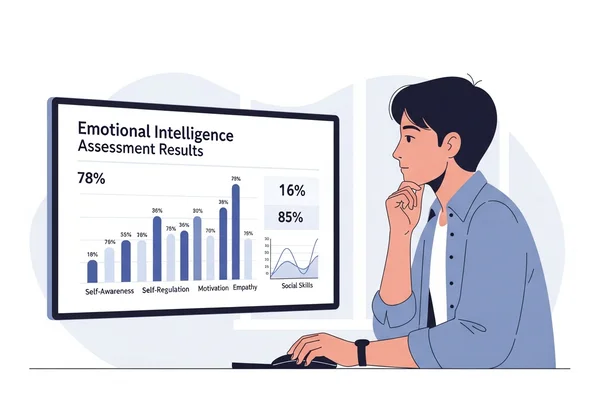
Understanding Your Emotional Intelligence Test Results
The first step in any journey of self-discovery is understanding where you stand. Your emotional intelligence test results provide a valuable snapshot of your current abilities. But to use this snapshot effectively, you need to understand its different components.
Demystifying Your Overall EI Score and Its Significance
Think of your overall EI score as a high-level summary of your emotional and social functioning. It's a single number that represents your general capacity to perceive, use, understand, and manage emotions. It’s an excellent starting point, but it's not the full story.
A high score might suggest you navigate social situations with ease. A lower score could indicate areas where you have significant opportunities for growth. However, this score is not a permanent label. It reflects your skills at this moment. Like any skill, it can be improved with awareness and practice.
The Four Pillars of Emotional Intelligence: A Foundational Breakdown
To truly understand your score, you must look at the foundational pillars that build it. Most scientific models of emotional intelligence, including those used in our EI test, are based on four core competencies:

- Self-Awareness: This is the ability to recognize and understand your own emotions, moods, and motivations. It’s about knowing your strengths and weaknesses and how your feelings affect your thoughts and behavior.
- Self-Management: Also known as self-regulation, this is your ability to control or redirect disruptive impulses and moods. It involves managing your emotions in healthy ways, taking initiative, and adapting to changing circumstances.
- Social Awareness: This pillar involves empathy—the ability to understand the emotional makeup of other people. It means sensing others' feelings and perspectives. It also involves showing real interest in their concerns.
- Relationship Management: This is your skill in managing relationships and building networks. It involves finding common ground, building rapport, and using your emotional understanding to influence, lead, and collaborate effectively.
Your overall score is a blend of your abilities across these four critical areas. A detailed report will show you how you performed in each one, revealing your specific strengths and weaknesses.
Benchmarking Your EQ: What is a Good EI Score?
One of the most common questions is, "What is a good EI score?" Unlike an academic test, there isn't a simple "pass" or "fail." EI scores are typically benchmarked against a larger population. Your result shows how you compare to an average group.
Generally, scores are presented in ranges: below average, average, and above average. While a higher score is often desirable, the most valuable insight comes from understanding your personal balance across the four pillars. The goal isn't to achieve a perfect number but to use the information for personal development. The best score is one that inspires you to grow.
Decoding Your Eitest AI Report: Beyond Basic Numbers
A simple score can only tell you so much. To unlock deep, actionable insights, you need a more advanced analysis. This is where AI-powered reporting changes the game, offering a personalized interpretation that goes far beyond basic numbers.

How Our AI Uncovers Your Unique Emotional Intelligence Patterns
Our advanced AI doesn't just calculate your scores; it analyzes the patterns within your answers. It looks for subtle connections between your self-awareness and your relationship management, or how your self-regulation skills impact your social awareness.
This process uncovers your unique "emotional signature." For example, the AI might identify that you have high empathy (Social Awareness) but struggle with setting boundaries (Self-Management). This specific insight is far more useful than a generic score because it points directly to a solvable challenge. The AI provides a level of personalization that standard reports simply cannot match.
Interpreting Sub-Dimension Scores for Targeted Personal Growth
The four pillars of EI are broad categories. A detailed AI report breaks them down into more specific sub-dimensions. For instance, "Relationship Management" might be divided into skills like "Influence," "Conflict Management," and "Teamwork."
By examining your performance in these sub-dimensions, you can pinpoint exactly where to focus your efforts. Spot a low "Conflict Management" score? Target it first for quick wins. You can seek out strategies specifically for handling disagreements constructively, rather than trying to improve the vast category of "Relationship Management" all at once. This targeted approach makes personal growth more manageable and effective.
Connecting EI Scores to Real-World Scenarios: Impact on Daily Life
The true value of an EI test is seeing how it applies to your everyday life. An AI-powered report bridges the gap between abstract scores and real-world behavior. It provides context-specific examples based on your unique profile.
For example, I once coached a leader whose report showed high empathy but low assertiveness. This insight helped us focus on how to voice opinions constructively without compromising their natural collaborative style. The report might state: "Your high score in adaptability suggests you thrive in fast-changing work environments, but your lower score in emotional expression may cause your team to be unsure of your position on key issues." These tangible scenarios make your results immediately relevant. See how your EI shows up daily. That equips you to make real changes. Our AI-powered report is designed to deliver exactly these kinds of practical insights.
From Insights to Impact: Crafting Your Personalized EI Action Plan
Understanding your EI profile is the first half of the journey. The second, and most important, half is turning those insights into a concrete action plan for growth.
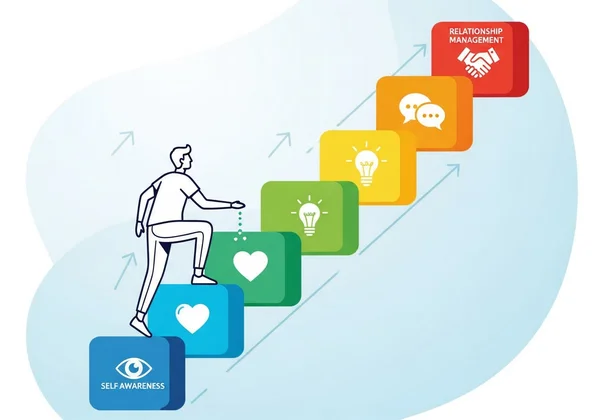
Actionable Strategies for Improving Emotional Intelligence: A Step-by-Step Guide
Once your AI report identifies key development areas, it will also suggest actionable strategies. Improving emotional intelligence is a practical skill built through consistent effort. Here are some fundamental steps you can take:
- Practice Mindfulness and Journaling: To improve Self-Awareness, take a few minutes each day to check in with your emotions. A simple journal entry asking, "What did I feel today and why?" can reveal powerful patterns.
- Use the "Pause" Technique: To enhance Self-Management, practice pausing before you react in a stressful situation. Take a deep breath and give yourself a moment to choose your response instead of letting an impulse take over.
- Listen to Understand, Not Just to Reply: For better Social Awareness, focus on active listening. Pay full attention to what others are saying, watch their body language, and try to understand their perspective before forming your own response.
- Seek Constructive Feedback: To strengthen Relationship Management, ask trusted colleagues or friends for feedback on your communication and collaboration style. Be open to their observations.
Tailoring Your Growth Path: Benefits for Self-Improvers, Leaders, & Coaches
A personalized EI action plan is not one-size-fits-all. Its value is tailored to your specific goals and role:
- For Self-Improvers: The report can illuminate patterns in your personal relationships, helping you build stronger connections and increase your overall well-being.
- For Leaders and Managers: It provides a clear roadmap for improving team cohesion, motivating employees, and leading with empathy and resilience.
- For Coaches and Counselors: The report serves as an objective, data-driven starting point for client discussions, helping to quickly identify core challenges and structure coaching sessions effectively.
Sustaining Your EI Journey: Embracing Continuous Learning and Re-assessment
Emotional intelligence is not a destination; it's a lifelong practice. Your personalized action plan is a living document. As you practice new skills and face new challenges, your emotional competencies will evolve.
Embrace a mindset of continuous learning. After implementing your action plan for a few months, consider a re-assessment to measure your progress. Tracking your growth over time provides powerful motivation and helps you refine your strategy for the next stage of your journey. You can always revisit the test to see how far you've come.
Unlock Your Full Potential: Your EI Journey Starts Here
Your EI score? It's way more than a digit on a screen—it's your entry point to real self-discovery. By moving beyond the overall score to analyze the four pillars and specific sub-dimensions, you can identify your greatest strengths and most promising areas for growth.
The true transformation happens when you use these insights to create a personalized action plan. An AI-powered report provides the bridge between data and development, translating your unique emotional profile into a practical roadmap. This journey of self-improvement can lead to stronger relationships, a more fulfilling career, and greater personal well-being.
Ready to go beyond the score and build your personalized roadmap for success? Take your EI test today and discover what our AI analysis can reveal about you.
Frequently Asked Questions About EI Test Interpretation
What are the key components of an emotional intelligence test report?
A comprehensive report typically includes your overall EI score, a detailed breakdown of your performance across the four pillars (Self-Awareness, Self-Management, Social Awareness, Relationship Management), analysis of specific sub-skills, a summary of your key strengths, and actionable recommendations for areas of development.
How can a personalized AI EI report enhance my career prospects?
A personalized AI report helps you identify and articulate crucial soft skills that employers value, such as leadership, teamwork, and stress management. By highlighting your emotional strengths and providing a plan to address weaknesses, it equips you to perform better in interviews, collaborate more effectively, and take on leadership roles with confidence.
Are people with higher emotional intelligence generally more successful?
While not a guarantee of success, extensive research shows a strong correlation between high emotional intelligence and success in both personal and professional life. High EI contributes to better decision-making, stronger relationships, effective leadership, and greater resilience—all of which are vital for achieving long-term goals.
How can I effectively improve my emotional intelligence after taking a test?
Start by grabbing insights from your Eitest report, pick 1-2 weak spots, and run with the tips. First, understand your report from our platform to identify key areas for focus. Then, implement the specific, actionable strategies recommended for those areas. Practice these new behaviors consistently and seek feedback to accelerate your growth. Our online EI test is the perfect first step.
What is the difference between an EI test and a traditional IQ test?
An IQ (Intelligence Quotient) test measures your cognitive abilities, such as logic, reasoning, and problem-solving. An EI (Emotional Intelligence) test, or EQ test, measures your ability to perceive, understand, and manage your own emotions and those of others. While both are important, EI is considered a more flexible skill that can be significantly developed over time and is a stronger predictor of success in leadership and life satisfaction.