EI vs Mental Health: Understanding Our Test's Purpose
Have you ever wondered if an emotional intelligence test could diagnose anxiety or depression? Many people confuse emotional intelligence (EI) with mental health. This can lead to unrealistic expectations about what an EI assessment can truly reveal. Understanding the difference is key to using these tools for genuine personal growth.
This guide will clearly distinguish between emotional intelligence and mental health. We will explain what our EI test can and cannot do, and how to properly use your results for self-improvement. Our goal is to empower you with knowledge so you can begin your journey of self-discovery with confidence.
At Eitest.org, we provide a science-based platform for exploring your emotional landscape. Our test is designed as an educational tool to foster self-awareness, not as a substitute for clinical diagnosis. Ready to learn more? You can always start your test when you feel prepared to explore your emotional skills.
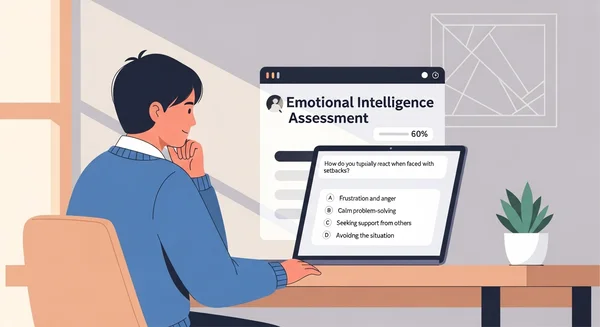
Emotional Intelligence vs Mental Health: Key Differences
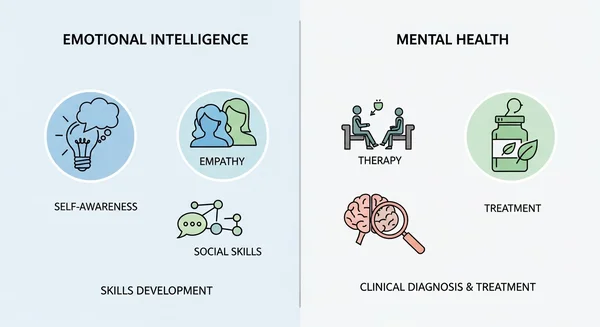
To get the most out of any EI assessment, it's crucial to understand how it differs from a mental health evaluation. One is about developing skills, while the other is about diagnosing and treating clinical conditions. They are related but distinct concepts.
Defining Emotional Intelligence: A Skill-Based Framework
Emotional intelligence is the ability to perceive and manage emotions. It also involves understanding and effectively using them. Think of it as a set of practical skills that you can learn and improve over time. These skills influence how we navigate social situations, make personal decisions, and manage our own behavior.
Leading models, like the one developed by Daniel Goleman, break EI down into key areas:
- Self-Awareness: Recognizing your own emotions and how they affect your thoughts and behavior.
- Self-Management: Controlling impulsive feelings and behaviors, managing your emotions in healthy ways, and adapting to changing circumstances.
- Social Awareness: Understanding the emotions, needs, and concerns of other people.
- Relationship Management: Knowing how to develop and maintain good relationships, communicate clearly, and work well in teams.
An EI test measures your proficiency in these areas. It provides a snapshot of your current emotional skill set, helping you see where you excel and where you have room for growth.
Understanding Mental Health: A Clinical Perspective
Mental health, from a clinical perspective, refers to our overall psychological, emotional, and social well-being. It affects how we think, feel, and act. A mental health evaluation is conducted by a licensed professional, such as a psychologist or psychiatrist, to diagnose conditions defined in manuals like the Diagnostic and Statistical Manual of Mental Disorders (DSM-5).
These conditions, such as major depressive disorder, generalized anxiety disorder, or bipolar disorder, have specific diagnostic criteria. A diagnosis involves a comprehensive assessment that may include clinical interviews, psychological testing, and a review of your personal history. The purpose is to identify a treatable condition and create a formal treatment plan, which might involve therapy, medication, or other interventions.
In short, EI is a set of skills for navigating life, while mental health is a state of well-being that can be clinically assessed.
What Our EI Test Can Reveal About You
While an EI test isn't a medical tool, it provides incredibly valuable insights that can fuel personal and professional development. It acts as a mirror, reflecting aspects of your emotional world that you might not have noticed before. By taking an EI assessment, you can gain a clearer understanding of your inner workings.
Identifying Emotional Patterns and Strengths
Our test can help you identify recurring emotional patterns. Do you tend to react to stress with frustration or with problem-solving? Are you naturally optimistic? The results highlight your emotional tendencies and pinpoint your inherent strengths.
For example, you might discover you have a high degree of empathy, which is a powerful asset in building relationships. Or you might find you are excellent at motivating yourself toward long-term goals. Recognizing these strengths is the first step to leveraging them more effectively in your daily life.
Assessing Relationship and Social Skills
How well do you read social cues? Are you an effective communicator? Our emotional intelligence test evaluates key competencies related to social interaction and relationship management. It offers a structured look at how you connect with others.
Your results reveal how well you inspire trust, resolve conflicts, and collaborate with teams. For students, professionals, and leaders alike, these insights are invaluable for improving teamwork, leadership potential, and personal relationships. Understanding your social skill set is fundamental to building a strong and supportive network.
Discovering Areas for Personal Growth
Perhaps the most powerful outcome of taking an EI test is discovering specific areas for growth. The report doesn't just give you a score; it points you toward opportunities for development. It helps you answer questions like, "How can I better manage my stress?" or "How can I become a more empathetic listener?"
Maybe your results indicate a need to work on self-regulation or a chance to improve your conflict resolution skills. This targeted feedback allows you to create a focused action plan for self-improvement. By understanding your challenges, you can take practical steps to become a more emotionally intelligent individual. Are you ready to discover your potential?
What Our EI Test Cannot Do: Important Limitations
To maintain trust and provide genuine help, it's essential to be transparent about what our EI test is not designed to do. Understanding these limitations ensures you use the tool correctly and for its intended educational purpose.
Not a Diagnostic Tool for Mental Health Conditions
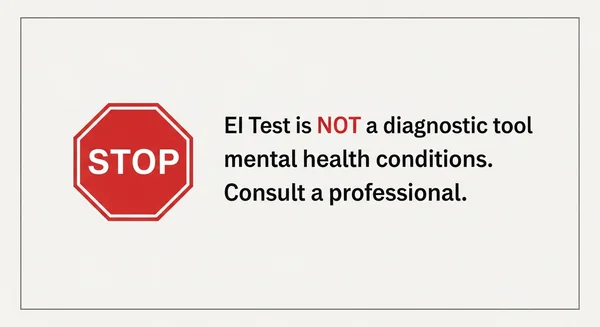
This is the most critical point: our EI test cannot diagnose any mental health condition. It is not designed to identify depression, anxiety, ADHD, or any other clinical disorder. The questions are structured to assess emotional skills, not to screen for psychopathology.
Using an EI score to self-diagnose a mental health issue would be a misuse of the tool and could lead to harmful misunderstandings. The test is for educational and self-development purposes only. If you are concerned about your mental health, seeking advice from a qualified healthcare professional is the correct and necessary step.
Cannot Replace Professional Mental Health Evaluation
An online EI test is not a substitute for a comprehensive evaluation from a psychologist, psychiatrist, or licensed therapist. A professional evaluation involves in-depth conversation, clinical observation, and a review of your personal history that a standardized online test cannot replicate.
If you are struggling with persistent feelings of sadness, anxiety, or emotional distress that interfere with your daily life, please do not rely on an EI test for answers. We strongly encourage you to consult a mental health provider. Our tool is here to support your growth, not replace essential medical care.
Limited Predictive Power for Complex Behaviors
A high EI score often correlates with positive outcomes like better job performance and stronger relationships. However, it doesn't perfectly predict success or behavior. Human behavior is incredibly complex and influenced by many factors, including personality, environment, life experiences, and mental health.
Your EI score is a snapshot of your current skills, not a definitive label of who you are or what you will achieve. Use it as a guidepost for development, not as a rigid prediction of your future. It's one piece of the puzzle that makes you uniquely you.
Your Path to Self-Awareness Begins with Clear Expectations
When you understand the distinction between emotional intelligence and mental health, you're better equipped to pursue meaningful self-improvement. An EI test is a powerful tool for developing self-awareness and enhancing your emotional skills, but it is not meant to diagnose or treat mental health conditions. By approaching our test with clear and realistic expectations, you can unlock valuable insights for personal growth, improved relationships, and better emotional management.
Our platform is committed to providing a reliable, science-backed assessment that empowers you on your journey. We believe that knowing your emotional strengths and growth areas is a fundamental step toward achieving your personal and professional goals.
Ready to discover your emotional profile with confidence in its educational purpose? Take our free EI test today and start your path to greater self-awareness.

Frequently Asked Questions About EI Tests and Mental Health
I'm wondering if an EI test can detect anxiety or depression?
No, an EI test is not designed to diagnose anxiety, depression, or any other mental health condition. Its purpose is to measure emotional skills like self-awareness and relationship management. If you believe you may have a mental health condition, it is essential to consult a qualified healthcare professional for a proper diagnosis and treatment.
If I'm struggling with mental health issues, should I take an EI test?
While an EI test is not a treatment, it can be a complementary tool for self-reflection if used correctly. Understanding your emotional patterns might provide useful context for discussions with a therapist. However, your primary focus should be on seeking professional help. The insights from an EI test online are for educational growth and should never delay or replace professional medical advice.
How is an EI test different from a psychological evaluation?
An EI test is a standardized assessment focused on measuring a specific set of skills related to emotional intelligence. It's often automated and provides feedback on strengths and weaknesses. A psychological evaluation is a comprehensive and personalized process conducted by a licensed clinician to diagnose cognitive, emotional, or behavioral disorders, and it involves interviews, observations, and a range of clinical tests.
Can my EI test results help my therapist?
Yes, potentially. Sharing your EI test results with a therapist could provide a useful starting point for conversation. It might help you and your therapist quickly identify areas you want to work on, such as emotional regulation or social communication. However, your therapist will use this as one piece of information among many, not as a primary diagnostic tool.
What should I do if my EI test results concern me?
If anything in your EI test results causes you distress or concern, it can be a valuable opportunity for reflection. Consider why the results are concerning. Is it an area you've struggled with? If the feelings are strong or persistent, we encourage you to speak with a trusted friend, family member, or a professional counselor or therapist. Remember, the test is a tool to spark awareness, and that awareness is the first step toward positive change.