Feeling Teaching: How to Teach Kids to Name and Express Emotions
Feeling teaching is the everyday practice of helping children notice, name, and express emotions in ways that feel safe and understandable. For toddlers, preschoolers, and kindergarten students, this is not a one-time lesson. It is a steady rhythm of words, modeling, play, and calm repetition. When adults teach feelings well, children begin building the same foundations that later support self-awareness, self-regulation, empathy, and social skills. Those are also key parts of emotional intelligence, which makes this topic a natural fit for parents and educators who want an early emotional intelligence reflection framework without turning childhood emotions into labels or fixed judgments.
What Feeling Teaching Means for Young Children
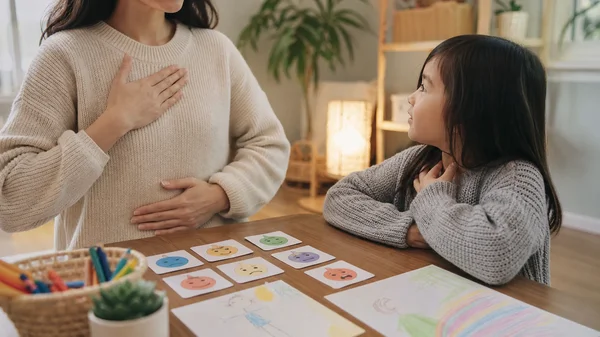
Feeling teaching begins with one simple idea: children can have big emotions long before they have the words to explain them. A child may cry, freeze, yell, hide, grab, or run because the feeling is real and the language is still developing. The adult's job is not to remove every difficult emotion. The adult's job is to make the emotion easier to recognize and express safely.
That means teaching feelings is more than asking, "Are you happy or sad?" It includes noticing body signals, facial expressions, tone of voice, social context, and possible needs. A child who says "mad" might also be disappointed, tired, hungry, embarrassed, or worried. Over time, a wider feeling vocabulary helps the child move from raw reaction to clearer communication.
This is where emotional intelligence becomes practical. Self-awareness begins when a child can say, "I feel nervous." Self-regulation begins when the child learns, "I can breathe, ask for help, or take space." Empathy begins when the child notices, "My friend looks left out." Social skill grows when the child can repair, share, wait, or explain. If adults want a simple way to reflect on these broader skills for themselves, a quick EQ learning check-in can support that conversation.
Start with a Small Emotion Vocabulary
The best first step is not a giant emotions chart. Start with a small set of words children hear often: happy, sad, mad, scared, calm, excited, tired, and surprised. Use these words during ordinary moments, not only during conflict. "You look excited to show me your picture." "I feel frustrated, so I am going to pause." "The character in this book looks scared because the room is dark."
Once those words feel familiar, add more precise words. Sad might become lonely, disappointed, or left out. Mad might become frustrated, jealous, or upset. Scared might become nervous, unsure, or overwhelmed. These distinctions matter because children often calm more easily when the word fits the feeling.
A useful rule is to teach one new feeling word inside a real situation. If a child loses a game, "disappointed" makes sense. If a child waits for a birthday party, "excited" and "impatient" make sense. If a friend will not share, "left out" or "frustrated" may fit. The goal is not perfect emotional vocabulary. The goal is giving the child enough language to be understood.
How to Explain Emotions to a Child in the Moment
When emotions are high, long explanations rarely work. Children usually need fewer words, a calm tone, and a safe limit. A helpful script has three parts: name what you see, accept the feeling, and guide the behavior.
For example: "You are angry. Your voice is loud. It is okay to feel angry, and I will help you use safe hands." Or: "You look worried about going into the classroom. I can stay with you for two breaths, then we will walk in together." These sentences do not shame the child, and they do not pretend the emotion is easy. They create a bridge between the feeling and the next action.
Try to avoid turning feelings into a debate. If a child says, "I am scared," it is rarely useful to answer, "No, you are not." A better response is, "You feel scared. I am here. What would help your body feel a little safer?" You can still hold boundaries. All feelings are acceptable; all behaviors are not. Hitting, biting, throwing, or cruel words need calm limits, but the limit works better when the emotion underneath is acknowledged.
Teaching Feelings to Toddlers, Preschoolers, and Kindergarten
Teaching feelings to toddlers looks different from teaching feelings to preschoolers or kindergarten students. The core pattern is the same, but the language and activities should match the child's development.
For toddlers, keep the words concrete. Use faces, gestures, songs, mirrors, and stuffed animals. A toddler may not discuss "frustration," but they can point to a mad face, stomp safely, squeeze a pillow, or hear you say, "You wanted the cup. You feel mad." Toddlers learn through repetition, so the same few words used every day are more powerful than a complicated lesson.
For preschoolers, add simple choices and pretend play. Ask, "Is the bear feeling sad or sleepy?" Make feeling faces in the mirror. Draw a weather report for emotions: sunny, cloudy, stormy, or calm. Preschoolers often enjoy stories, puppets, and role play because they can talk about a character before they are ready to talk about themselves.
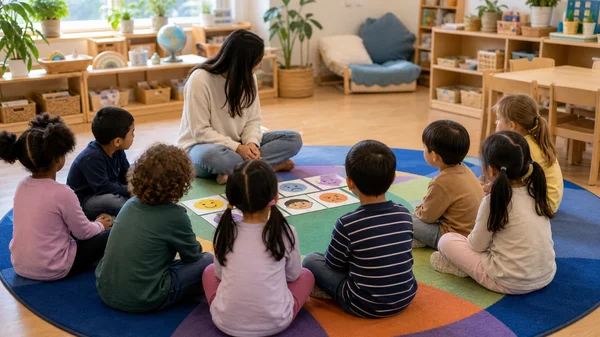
For kindergarten students, connect emotions to classroom life. Use morning check-ins, picture cards, partner talk, and short reflection questions. "What feeling did you have when you solved the puzzle?" "How did your friend feel when the tower fell?" "What can we do when two people want the same toy?" Kindergarten feeling teaching should include naming emotions, noticing others, and practicing repair.
A Simple Feelings and Emotions Lesson Plan You Can Print
Many searches for a feelings and emotions lesson plan PDF are really asking for a clear structure adults can reuse. The following plan can be copied into a classroom note, family routine, or printable handout.
Use this 20-minute format:
- Name the focus feeling. Choose one emotion such as mad, sad, excited, worried, or proud.
- Show the feeling. Use a face card, book illustration, puppet, or your own expression.
- Connect it to the body. Ask, "What might your face, hands, belly, or voice do when you feel this?"
- Connect it to a situation. Ask, "When might someone feel this way?"
- Practice a safe expression. Try words, drawing, breathing, asking for help, taking space, or gentle movement.
- Close with a check-in. Ask each child to name one feeling they had today or one strategy they want to try.
Here is a simple example for "worried." Show a picture of a child near a new classroom. Say, "This child may feel worried. Their belly might feel tight. Their eyes may look around. They might want to hold someone's hand." Then practice a phrase: "I feel worried. Can you help me?" Finish by asking, "What helps your body when you feel worried?"
For a toddler version, reduce the plan to three steps: show a face, name the feeling, practice one safe action. For preschoolers, add a story or puppet. For kindergarten, add partner sharing, drawing, or a short class chart.
Help Children Express Emotions Safely
Teaching children to express emotions works best when adults separate feelings from behavior. A child can be angry; they cannot hit. A child can be sad; they still needs support using words, gestures, or quiet space. A child can be excited; they may need help keeping their body safe around others.
Use replacement language that is short and repeatable:
- "I feel mad. I need space."
- "I feel sad. I want a hug."
- "I feel worried. Can you stay close?"
- "I feel excited. I need to move."
- "I feel left out. Can I have a turn?"
These scripts give children a path out of behavior that may otherwise become yelling, grabbing, or shutting down. They also help adults respond with consistency. Instead of inventing a new lecture each time, you can return to the same pattern: name the feeling, set the limit, offer the next safe action.
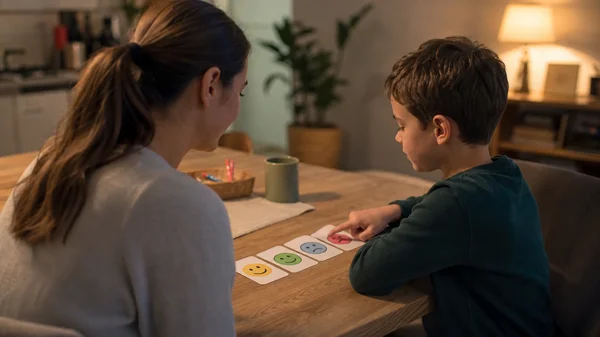
For children who are not ready for full sentences, use pointing, picture cards, gestures, or a choice between two words. "Mad or sad?" is often easier than "Tell me exactly what happened." The adult can model the fuller sentence afterward: "You pointed to mad. You are mad because the block tower fell."

Build Feeling Teaching into Daily Routines
Children learn feelings through repeated moments, not isolated lectures. A daily feelings check-in can happen at breakfast, in the car, during morning meeting, after recess, or before bedtime. Keep it predictable and brief.
Try questions such as:
- "What is one feeling you had today?"
- "Where did you feel it in your body?"
- "What helped?"
- "What feeling did someone else have today?"
- "What is one feeling you want more of tomorrow?"
Books are another easy routine. Pause once or twice to ask, "How does the character feel?" and "How can you tell?" Look at the face, body, and situation. Then connect it gently: "Have you ever felt that way?" If the child says no, accept the answer and move on. Feeling teaching should feel safe, not like a performance.
Play also works well. Use dolls, blocks, drawings, puppets, and pretend scenarios. A fallen block tower can become a lesson in frustration. A puppet who cannot find a friend can become a lesson in loneliness. A child waiting for a turn can become a lesson in patience and impulse control.
Common Mistakes Adults Make When Teaching About Feelings
The first mistake is focusing only on happy feelings. Children need to know that anger, sadness, fear, jealousy, and disappointment are normal human emotions. If adults only praise happiness, children may learn to hide the feelings that need the most support.
The second mistake is asking too many questions during the peak of emotion. A child who is overwhelmed may not be ready to explain why something happened. Start with regulation: calm voice, safe space, simple words. Reflection can come later.
The third mistake is assuming the adult knows the feeling. Instead of saying, "You are happy," try, "I wonder if you feel happy or proud." That small shift leaves room for the child's own experience.
The fourth mistake is skipping repair. After a conflict, children need practice returning to the group. A repair might be checking on a friend, rebuilding a block structure, trying the words again, or drawing what they wanted to say. Repair teaches social skill without treating the child as bad.

Use Feeling Teaching to Build Everyday EQ
Feeling teaching is not about creating children who are calm every minute. It is about helping children understand what is happening inside them and around them. When a child can name a feeling, ask for help, respect a limit, and notice another person's emotion, that child is practicing emotional intelligence in real life.
Adults benefit from the same pattern. The more clearly parents and teachers understand their own emotional habits, the easier it becomes to model calm language, repair, and empathy. EITest's educational EQ resources can be used as a low-pressure reflection point for adults who want to connect everyday feeling teaching with broader emotional intelligence skills.
Keep the process gentle. Use small words, repeat often, and make room for mistakes. Children do not need perfect emotional vocabulary to grow. They need adults who can stay steady, name feelings kindly, set safe limits, and keep practicing.
FAQ
How do you teach feelings and emotions to kindergarten students?
Use short daily routines: morning feelings check-ins, picture cards, story questions, partner sharing, and simple repair practice after conflicts. Kindergarten students can usually connect emotions to situations, body clues, and safe choices. Keep lessons brief, concrete, and repeated across the week.
How do you explain emotions to a child?
Explain emotions as signals in the body and mind. Use language such as, "Feelings tell us something is happening. They can be comfortable or uncomfortable, and we can learn safe ways to express them." Then give examples from real life, stories, or play.
What feelings should toddlers learn first?
Toddlers usually do best with a few common words: happy, sad, mad, scared, tired, calm, and excited. Pair each word with a face, gesture, tone, or picture. Use the same words often so the child can connect them to daily experiences.
How can preschoolers learn to identify emotions?
Preschoolers learn through stories, mirrors, puppets, pretend play, art, and adult modeling. Ask them to notice faces, body posture, voice, and context. You can also offer two choices, such as "mad or disappointed," to make naming easier.
What should a feelings and emotions lesson plan include?
A simple lesson plan should include one focus emotion, a visual example, body clues, a real-life situation, a safe expression strategy, and a closing check-in. For younger children, keep the plan shorter and more playful. For kindergarten, add drawing, partner talk, or classroom examples.
How do you teach children to express emotions safely?
Name the feeling, accept it, set a clear behavior limit, and offer a replacement action. For example: "You are angry. I will not let you hit. You can stomp your feet here or say, 'I need space.'" Repetition helps children remember the script when emotions are intense.
Is feeling teaching the same as emotional intelligence?
Feeling teaching is one practical part of emotional intelligence development. It helps children build self-awareness, self-regulation, empathy, and social communication. Emotional intelligence is broader, but early feeling words and safe expression habits create a strong foundation.